
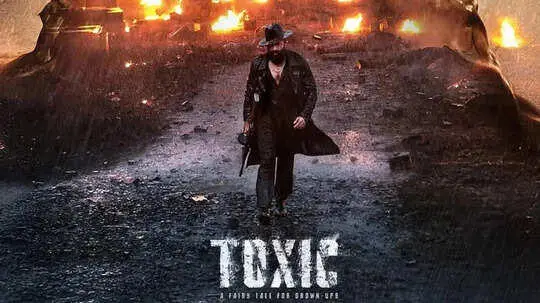
- 1 Toxic review of teaser: Yash delivers powerful visuals, but why does intensity still mean sex, violence and machismo?
- 2 Toxic Review of teaser: A Teaser That Lives Up To Its Name
- 3 Toxic Review of Teaser: When Viewers Push Back
- 4 Toxic Review of Teaser: The Responsibility Of Influence
- 5 Toxic Review of Teaser: We Already Know Clean Content Can Win
- 6 Toxic Review of Teaser: The Fine Line Between Edge And Excess
- 7 Toxic Review of Teaser: Controversy As Marketing Currency
- 8 Toxic Teaser Review: Waiting For The Film To Speak
Toxic Review of teaser: I cannot deny the scale of the moment. The teaser of Toxic: A Fairy Tale for Grown-Ups racing towards 100 million views is not just a statistic; it is a reminder of Yash’s formidable star power. Ever since KGF: Chapter 2, his screen presence has operated like a magnet, pulling audiences across languages and borders. Naturally, expectations for his next outing were astronomical, and visually, Toxic appears determined to meet them with stylised frames, slick action and brooding intensity.
Yet while watching it, I found myself asking a question I did not expect: why does spectacle today so often arrive hand-in-hand with provocation?
The title Toxic is not subtle, and the teaser seems intent on proving it deserves that label. The now-viral scene of Yash’s character Raya in an intimate moment inside a car parked beside a cemetery — while someone plants a bomb detonator outside — is undoubtedly striking cinema grammar. It is bold, tense, and designed to jolt.
But it also feels deliberately discomforting, as though the shock itself is part of the marketing strategy. I could see why some viewers praised the daring staging, yet I could equally understand why others recoiled. The teaser does not merely flirt with edginess; it embraces it fully, almost daring audiences to object.
And object they did. Complaints reportedly reached the Karnataka State Commission for Women, with concerns raised about the portrayal of women and cultural representation. Another protest came from a Christian organisation that felt certain imagery was religiously insensitive. Whether one agrees with these objections or not, their existence signals something important: audiences today are not passive consumers. They watch, analyse, question and respond.
Toxic Review of Teaser, What complicates matters further is the resurfacing of Yash’s old interview in which he stated he would avoid scenes he would feel uncomfortable watching with his parents. That clip circulating now has fuelled accusations of contradiction. I do not see this as a simple case of hypocrisy, but rather as a reflection of how stardom changes expectations. When an actor becomes a role model to millions, every creative choice is judged against the image fans have built of him.
Toxic Review of Teaser, This is where my unease deepens. Cinema is entertainment, yes, and actors are performers, not moral guardians. But it would be naïve to pretend that films do not shape behaviour. I have seen young boys mimic dialogue, posture and even attitudes from films like Kabir Singh and Animal, admiring aggression as though it were charisma. When characters steeped in rage and entitlement are framed as heroic, imitation is inevitable.
Yash commands a fanbase that borders on devotional. For many admirers, he is not just a star; he is a template. That level of influence brings with it an unspoken responsibility, whether one likes it or not.
What makes this trend puzzling is that Indian cinema has repeatedly proven it does not need titillation or hyper-masculine rage to succeed. Films such as Kantara, Tumbbad, and even genre-blending entertainers like Munjya have captivated audiences through atmosphere, storytelling and rootedness rather than shock value. They demonstrate that intensity can exist without explicitness, and power without performative brutality.
I remember leaving Kantara awestruck not because it pushed boundaries of provocation, but because it respected the intelligence and imagination of its viewers. That, to me, is real cinematic confidence.
To be clear, I am not arguing for sanitised cinema. Art must have freedom to explore darkness, desire and danger. Stories about flawed men or morally grey worlds are not inherently harmful. The problem arises when provocation becomes formula — when sex, violence and toxic masculinity are treated as shortcuts to intensity rather than tools of storytelling.
The Toxic teaser, for all its technical polish, gives me the sense that it is trying very hard to appear dangerous. True danger in cinema, however, rarely announces itself so loudly. It creeps in quietly, unsettles the mind, and lingers long after the screen fades.
There is also the undeniable truth that controversy sells. Debate fuels algorithms; outrage drives clicks. The growing view count proves that curiosity and criticism often work together as promotional machinery. Whether intentional or accidental, the chatter surrounding Toxic has already ensured that the film is one of the most discussed releases on the horizon.
From a business standpoint, that is a triumph. From a cultural standpoint, I am still deciding.
Ultimately, a teaser is only a fragment, not a verdict. When Toxic releases, the full narrative may justify its provocative tone, contextualise its imagery, and silence doubts. Or it may confirm them. I am willing to wait and watch before drawing final conclusions.
For now, though, I remain caught between admiration and apprehension — impressed by the craft, intrigued by the ambition, yet uneasy about the familiar reliance on shock and swagger. If the teaser’s purpose was to provoke conversation, it has succeeded brilliantly.
After all, few things are more powerful than a film that leaves audiences arguing before it has even arrived.
